
SeromYx Systems, Inc. Appoints Andrew Ball, PhD, as Chief Executive Officer

Abigail Harris • February 5, 2025

Woburn, MA, February 5th, 2025SeromYx Systems, Inc. , a global leader in high-throughput antibody characterization and Systems Serology services, today announced the retirement of Chief Executive Officer, Mr. Piers Whitehead, a co-founder of the company, who will remain with the organization as a member of the Board of Directors and as a strategic advisor. Concurrently, as part of a planned transition, Andrew Ball, PhD has been appointed Chief Executive Officer and Director, effective February 4th, 2025.

Dr. Ball brings over 20 years of global leadership experience in the life sciences industry, with a successful track record in technical and commercial development of assay platforms and services. Most recently, he served as Vice President, Assay Development Platforms at Abcam, a Danaher company, where he led a global R&D organization developing and commercializing immunoassays, cell-based assays, antibody conjugates, recombinant proteins and contract assay services. He has also held roles as VP of Assay Development at Quanterix, developing ultrasensitive assays for neurodegenerative disease and immunooncology; as VP of R&D at Quad Technologies, a cell and gene therapy startup acquired by Bio-Techne, and has served in a variety of innovation and strategic leadership roles at MilliporeSigma.

Commenting on the appointment, Armin Spura, PhD, Executive Chairman of the Board of Directors said:

“On behalf of the Board, I want to thank Piers for his many contributions to SeromYx’s success since its founding. Under Piers’ leadership, SeromYx has grown to become successful and profitable, powered by the leading technology platform for Fc effector profiling. I am very pleased to announce the appointment of Dr. Andrew Ball as our new Chief Executive Officer. Andrew is a distinguished industry leader whose deep experience in assay development, insights into antibody development, and ability to bridge technical and commercial applications make him the ideal choice to lead SeromYx. We are confident that Andrew’s vision and strategic acumen will position SeromYx for continued success in the years ahead.”

Andrew Ball added:

I am excited to join SeromYx at this pivotal time as we continue to deliver for our clients and build on the strong foundations the company has established – with our comprehensive Fc effector function profiling platform. I believe SeromYx is uniquely positioned to deliver new insights into the correlation between function and clinical outcomes during therapeutic antibody discovery and development.

The company extends its gratitude to Piers Whitehead for his leadership and contributions, which have positioned SeromYx for continued success.

About SeromYx Systems, Inc.:
SeromYx Systems, Inc. is a global leader in providing GCLP high-throughput antibody characterization and Systems Serology services, offering advanced solutions for the comprehensive analysis of immune responses and correlation of antibody function with clinical outcomes. With a dedication to innovation and excellence, SeromYx is at the forefront of revolutionizing the field of vaccine and therapeutic antibody development through its cutting-edge technologies and strategic collaborations.

Contact:
Abigail Harris
Business Development Manager
Abigail.harris@seromyx.com
By Abigail Harris March 10, 2026
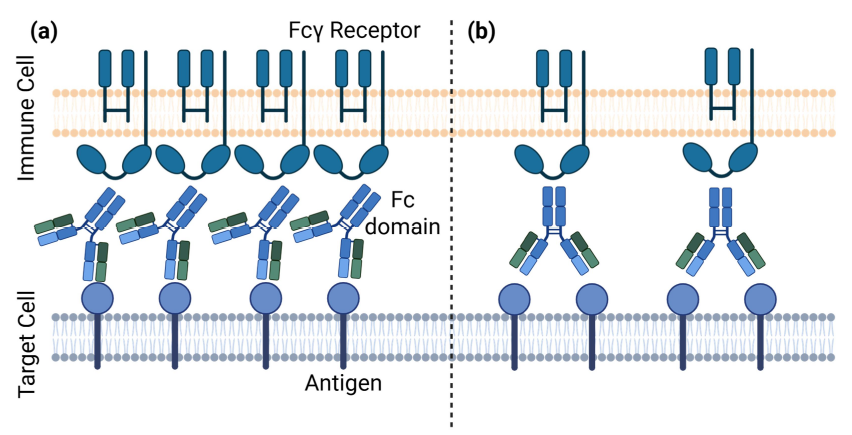
The Fc Review: How do antibody structure and binding dynamics shape ADCC signaling? A recent study in The AAPS Journal explores how multiple antibody design features, including Fab affinity, hinge flexibility, Fc engagement, and antigen density, influence antibody-dependent cellular cytotoxicity (ADCC) signaling. Background: ADCC is a key mechanism of action for many therapeutic antibodies, yet the strength of this response depends on more than Fcγ receptor binding alone. Productive immune activation requires antibodies to bridge target cells and effector cells within the immune synapse, forming receptor crosslinks that trigger downstream signaling. Using a combination of computational modeling and experimental data, this study examines how structural properties of antibodies influence these crosslinking events and ultimately shape ADCC signaling outcomes. The study highlights: ADCC signaling is influenced by multiple antibody properties, including Fab affinity, hinge flexibility, Fc receptor engagement, and antigen expression levels. Antibody structure affects how efficiently Fc receptors and target antigens are crosslinked within the immune synapse. In some cases, moderate Fab affinity supported stronger signaling by favoring productive crosslinking configurations. Antibody valency and hinge flexibility also influenced signaling outcomes by altering the geometry of immune synapse interactions.
February 12, 2026
The Fc Review: How well do our preclinical models capture human Fc biology? A new Science Immunology study takes a deep look at Fcγ receptor and FcRn expression across humans, non-human primates, and mice, highlighting how species-specific differences shape Fc-mediated immune function. Background: Fc-dependent activity is influenced not only by antibody design, but also by where and how Fcγ receptors are expressed across immune cell types and tissues. While animal models remain central to #antibody development, differences in Fcγ receptor biology across species can complicate interpretation of Fc-driven mechanisms. The study highlights: Species-specific differences in Fcγ receptor expression patterns across immune cell subsets and tissues. Context-dependent regulation of Fcγ receptors by inflammatory cues, with expression shifting across cell types and environments. These differences influence how Fc-mediated functions are engaged and interpreted across experimental systems. Cross-species variation in FcγR and FcRn biology helps explain why Fc-dependent effects observed preclinically may not always translate cleanly to human settings. 
January 21, 2026
The Fc Review: How are antibody developers actually using Fc engineering today? A recent analysis of the IMGT/mAb-DB database takes a systematic look at engineered Fc variants across therapeutic antibodies and fusion proteins, offering a real-world snapshot of how Fc design choices are being deployed in the clinic. Background: Fc engineering is often discussed in terms of individual mutations or isolated use cases. But at an industry level, it’s less clear how frequently Fc variants are used, which functions are prioritized, and whether antibodies rely on single or multiple Fc modifications. By mining curated entries in IMGT/mAb-DB, this study steps back to examine Fc engineering trends across approved and clinical-stage molecules. The review highlights: Fc engineering is widespread across therapeutic antibodies and fusion proteins cataloged in IMGT/mAb-DB Effector silencing strategies are commonly employed, particularly in programs prioritizing safety and controlled immune engagement Many molecules incorporate multiple Fc variants, rather than a single engineered change Fc modifications are used across a range of mechanisms and formats, underscoring Fc’s role as an intentional design lever
January 1, 2026
World Vaccine Congress US 2026
December 4, 2025
The Fc Review: Continuing our series taking a closer look at recent Fc-focused papers, what they found, and why it matters for antibody discovery and development. Can we program the Fc region? A recent bioRxiv preprint explores this question at scale, using millions of Fc variants to train machine learning models that predict functional outcomes across FcγR interactions. Background: Through engagement with Fc-receptors, the antibody Fc domain can direct a broad range of immune activities, including phagocytosis, cytokine release, antigen presentation, and immune cell polarization – each of which could be precisely tuned to combat disease. Fc engineering has traditionally focused on modifying one property at a time (E.g., ADCC, ADCP, or half-life). This work instead treats the Fc region as a functional design space and explores how sequence variations across the Fc domain can be linked to real immune engagement. 
November 20, 2025
The Fc Review: One Fc variant, three advantages? A Nature Communications study demonstrates how a single Fc-engineered IgG achieved improved half-life, mucosal distribution, and enhanced immune-mediated killing, across both cancer and bacterial models. Background: Fc engineering is often discussed through a single lens, half-life extension, effector boosting, or silencing. This paper explores a broader question: can an Fc variant containing three point mutations deliver multiple functional gains across different biological systems?
October 28, 2025
The Fc Review: How does Fc engineering shape bispecific antibody function? A Frontiers in Bioengineering and Biotechnology review explores how the Fc region can be tuned to control effector function, half-life, and safety, key levers in the design of next-generation bispecific antibodies ( bsAbs ). Background: Bispecific antibodies bring new therapeutic possibilities by engaging multiple targets at once. But this complexity also brings new challenges, from unwanted immune activation to altered pharmacokinetics . The Fc region plays a central role here, acting as both a stabilizing scaffold and a regulator of immune effector engagement
October 23, 2025
Abstract: Fc engineering to enhance antibody effector functions harbors the potential to improve therapeutic effects. Understanding FcγR expression and distribution in the tumor microenvironment prior to and following treatment may help guide immune-engaging antibody design and patient stratification. In this study, we investigated FcR-expressing immune effector cells in HER2 + and triple-negative breast cancers (TNBC), including neoadjuvant chemotherapy–resistant disease. FcγRIIIa expression, FcγRIIIa + NK cells, and classically activated (M1-like) macrophages correlated with improved anti-HER2 antibody efficacy. FcγRIIIa protein and FcγRIIIa + NK cells and macrophages were present in primary TNBC and retained in treatment-resistant tumors.
September 15, 2025
Background Authorized COVID-19 vaccines require boosters for continued protection; however, the lack of crossplatform compatible boosters creates practical challenges to keeping populations protected. Methods This Phase 3, multicenter, international, randomized, active-controlled trial compared UB-612 as a thirddose heterologous booster to BNT162b2, ChAdOx1-S, or BBIBP-CorV homologous boosters in healthy subjects aged ≥16 years. Participants were randomly assigned 1:1 to receive a single intramuscular injection of UB-612 or an active comparator matching the primary dose, and were stratified for age, sex, N-protein seropositivity, and time since the last dose of their primary series COVID-19 vaccination. The primary objective was to show noninferiority of neutralizing antibody geometric mean titer (GMT) against live SARS-CoV-2 Wuhan strain after boosting with UB-612 or each of the licensed platform vaccines. Secondary and exploratory objectives covered short and long-term antibody responses. The safety analysis addressed subject and investigator reported adverse events. The study was registered on ClinicalTrials.gov, NCT05293665, and completed on September 12, 2023.
September 9, 2025
The Fc Review: Continuing our series taking a closer look at recent Fc-focused papers, what they found, and why it matters for antibody discovery and development. How does Fc engineering shape the translation of antibodies from preclinical models to the clinic? A new industry-wide review with 15 case studies examines the impact of Fc modifications on pharmacology and safety, and the challenges of predicting human outcomes from nonclinical studies. Background: Fc regions do not only extend half-life, they drive functions like ADCC , ADCP, CDC, and immune modulation. Engineering the Fc can enhance, silence, or redirect these activities. But the same changes that deliver potency can also introduce risk, especially when preclinical models do not fully mirror human Fc receptor biology.
More Posts →