
Cross-species cellular mapping and humanization of Fcγ receptors to advance antibody modeling
The Fc Review:
How well do our preclinical models capture human Fc biology?
A new
Science Immunology study takes a deep look at Fcγ receptor and FcRn expression across humans, non-human primates, and mice, highlighting how species-specific differences shape Fc-mediated immune function.
Background:
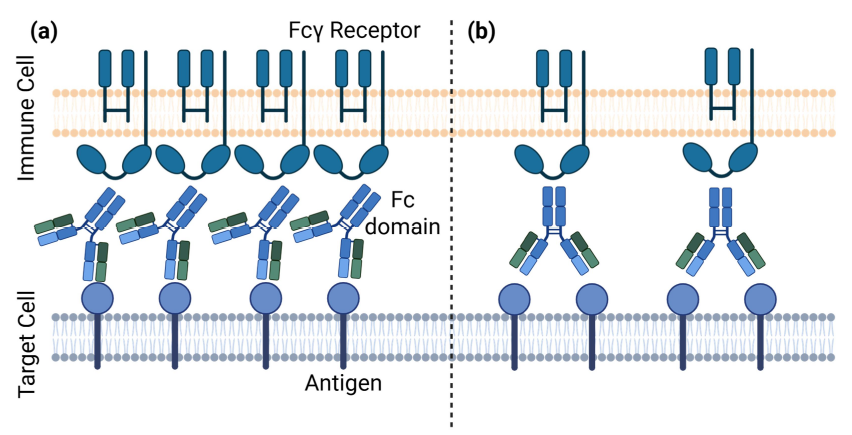
Fc-dependent activity is influenced not only by antibody design, but also by where and how Fcγ receptors are expressed across immune cell types and tissues. While animal models remain central to #antibody development, differences in Fcγ receptor biology across species can complicate interpretation of Fc-driven mechanisms.
The study highlights:
- Species-specific differences in Fcγ receptor expression patterns across immune cell subsets and tissues.
- Context-dependent regulation of Fcγ receptors by inflammatory cues, with expression shifting across cell types and environments.
- These differences influence how Fc-mediated functions are engaged and interpreted across experimental systems.
- Cross-species variation in FcγR and FcRn biology helps explain why Fc-dependent effects observed preclinically may not always translate cleanly to human settings.
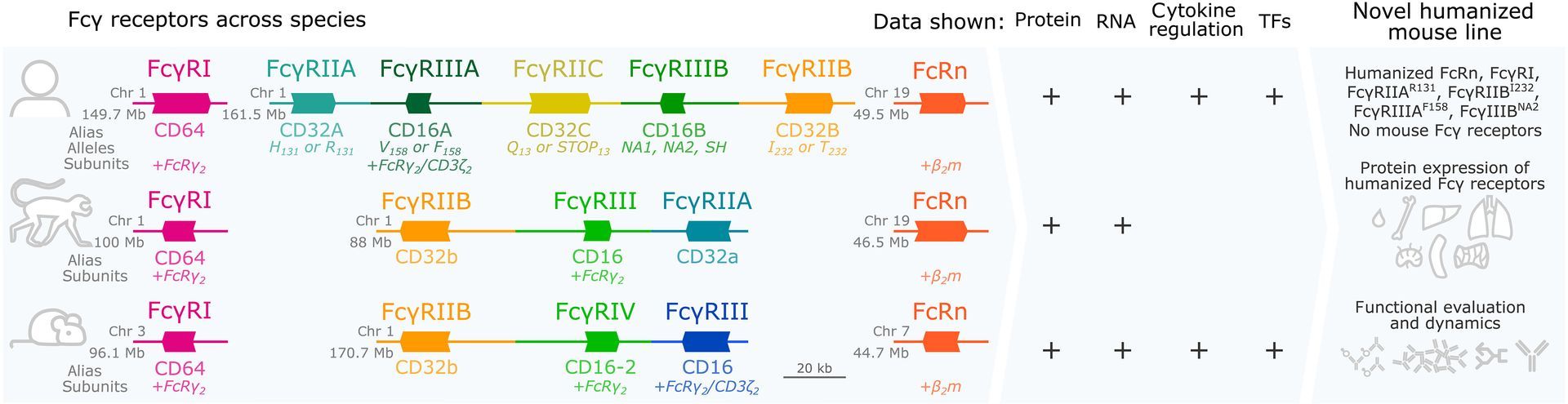
Fig. 1. Fcγ receptors across species, their genomic mapping, and the characterization of a mouse model with humanized Fcγ receptors. The genomic organization of the Fc receptor locus in human, cynomolgus macaque (M. fascicularis), and mouse is shown according to the UCSC Genome Browser. Similar colors indicate genes that were predicted to be orthologs, and arrows indicate the orientation of the genes. Heat-shock proteins in the Fc receptor locus are not shown. In this resource, we mapped receptors at the protein and transcriptomic level and summarized the influence of cytokines and TFs on their expression. To bridge differences between species, we generated and characterized a mouse model carrying the major IgG-binding receptors.
Implications for antibody development:
For programs where Fc activity is central to mechanism of action, or intentionally minimized, this work reinforces the importance of understanding how Fc biology differs across species. Interpreting Fc-driven efficacy or safety signals requires careful consideration of receptor expression, cellular context, and experimental system.
Our perspective:
As Fc engineering strategies become more deliberate, evaluating Fc behavior in systems that reflect human immune biology becomes increasingly important. Broad functional assessment across relevant Fc pathways can help ensure that design decisions translate as intended as antibodies move toward the clinic.
References:
Lambrecht BN et al. Cross-species mapping of Fcγ receptor and FcRn expression reveals translational differences in antibody effector biology. Science Immunology, 2026.