
Generative design of antibody Fc-variants with synthetic and programmable functional profiles
The Fc Review:
Continuing our series taking a closer look at recent Fc-focused papers, what they found, and why it matters for antibody discovery and development.
Can we program the Fc region?
A recent bioRxiv preprint explores this question at scale, using millions of Fc variants to train machine learning models that predict functional outcomes across FcγR interactions.
Background:
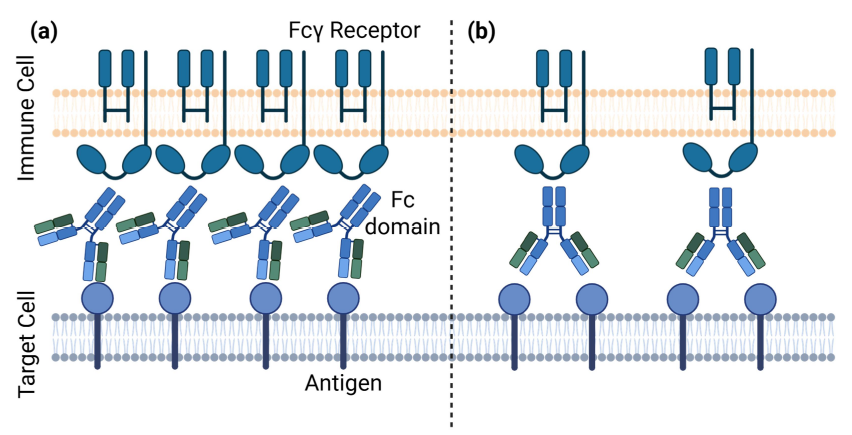
Through engagement with Fc-receptors, the antibody Fc domain can direct a broad range of immune activities, including phagocytosis, cytokine release, antigen presentation, and immune cell polarization – each of which could be precisely tuned to combat disease. Fc engineering has traditionally focused on modifying one property at a time (E.g., ADCC, ADCP, or half-life). This work instead treats the Fc region as a functional design space and explores how sequence variations across the Fc domain can be linked to real immune engagement.
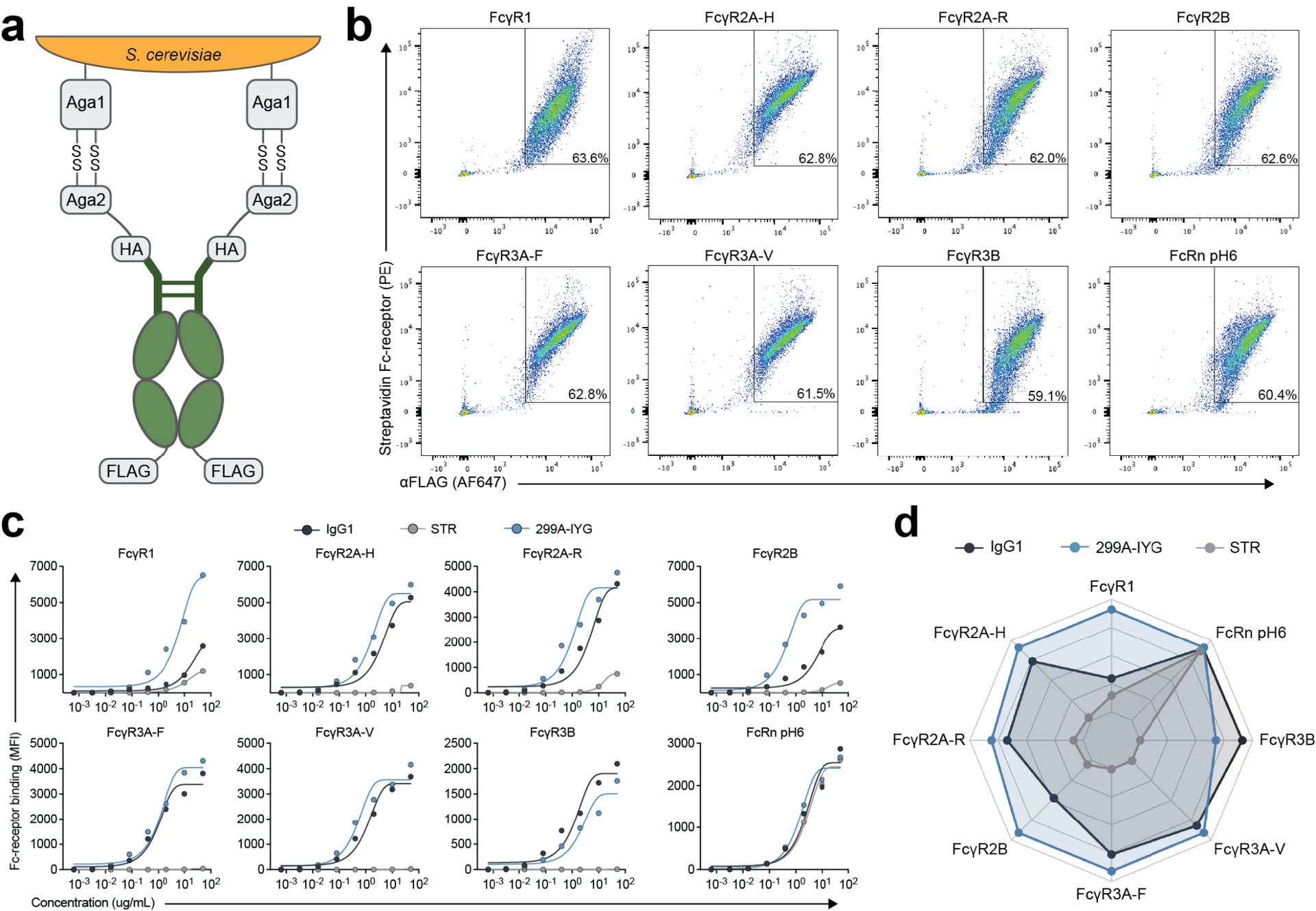
Fig. 1 | Development and characterization of an aglycosylated antibody Fc surface display system. a, Schematic of the antibody Fc yeast surface display approach. Image created with BioRender.com. b, Flow cytometry analysis of Fc-receptor binding in the yeast display system for wild-type human IgG1 Fc. X-axis: FLAG surface expression. Y-axis: Fc-receptor binding. Fc-receptors were used at a concentration of 50μg/mL. FcRn staining was performed at pH6. c, IgG1, aglycosylated Fc-variant 299A-IYG, and Fc null variant STR were stained across a titration series of each Fc-receptor. X-axis: Fc-receptor concentration. Y-axis: Fc-receptor binding (geometric mean fluorescence intensity) normalized to FLAG surface expression. Data were fitted using a sigmoidal (4-parameter logistic) curve. d, Radar plot showing the area under the binding curves from the Fc-receptor titration in panel c for IgG1, 299A-IYG, and STR.
The authors highlight:
- Large-scale Fc variant screening enables learning sequence–function rules across multiple FcγRs
- Deep-learning models trained on these data can predict receptor binding profiles based on Fc sequence
- The study expands functional exploration of Fc sequence space beyond what has previously been examined
- Multi-receptor binding patterns suggest that engineered Fc domains may need to be evaluated across multiple pathways, rather than relying on a single functional readout
Implications:
This work highlights a shift in how Fc engineering might evolve: instead of tweaking a known function, engineering may increasingly explore new functional profiles like tailored effector engagement, selective silencing, tissue targeting, or tunable immune activation. For developers advancing antibodies with Fc-dependent MOAs (or those designing Fc-silenced formats) this raises an important question:
How do we evaluate Fc behavior when relevant biology spans multiple immune pathways?
Our perspective:
As Fc formats evolve, the industry may move toward profiling Fc variants across broader biological contexts, including FcγR interactions, complement activity, and primary human immune cell engagement. That functional resolution could help guide engineering choices earlier, especially when Fc is central to MOA or purposefully silenced.